This article was originally published by Joe McAdory of the Auburn University Samuel Ginn College of Engineering on September 3, 2026.
Applied Research Institute, ECE researchers lead $1.4M effort to reinvent MRZR-Alpha 4 communications platform
By Joe McAdory
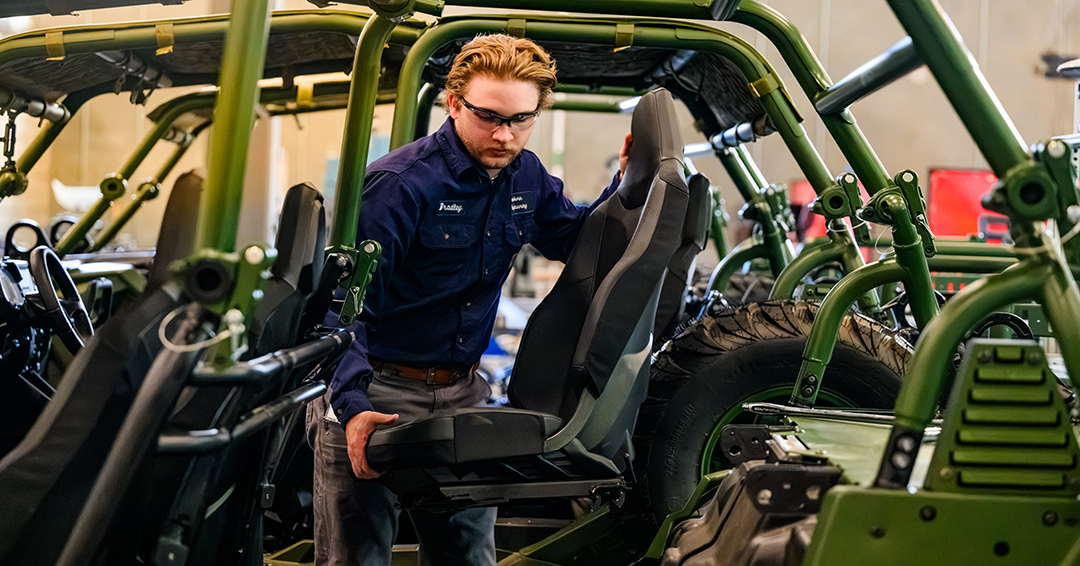
The U.S. Army’s Polaris MRZR‑Alpha 4 delivers the speed and agility expected of a lightweight, high‑mobility tactical vehicle. However, its design introduces communication hurdles that demand the reimagining of radio, satellite, and digital systems.
A team from the Auburn University Applied Research Institute (AUARI) and the Department of Electrical and Computer Engineering is working under a $1.4 million contract from the U.S. Army Combat Capabilities Development Command (DEVCOM) Army Research Laboratory’s Pathfinder Program to develop a solution.
The project, Mission Command Integration Module–XL (MCIM-XL), will create a commander’s communications suite built from the ground up for the Polaris MRZR-Alpha 4, unifying disparate radios, antennas, satellite links, and digital gear into a compact, durable system.
“We’re doing the concept development, the design engineering, the integration, and the testing evaluation, the whole thing,” said Steve Mills, principal investigator and project lead at Auburn. “We’re also providing the user a simulation and model that demonstrates their equipment is fully functional and safe for soldiers to operate.”
AUARI Principal Research Scientist Scott Thomas is overseeing structural analysis to ensure the MCIM‑XL can withstand the Army’s operational environment. Scott’s team will identify weaknesses before the system reaches a soldier, redesign components where needed, and verify through analysis that the entire structure will hold up under real‑world conditions.
“People don’t always realize how much stress these systems see before they ever get to the battlefield,” he said. “You need to think about vibration, shock, temperature swings — all the things that can cause a failure long before a soldier touches it. Our job is to make sure those problems are found early so the system performs the way it’s supposed to when it matters.”
Hunter Burch and Clint Snider, assistant professors within the Department of Electrical and Computer Engineering, are ensuring the MCIM‑XL’s communications suite is electrically sound. Burch, Snider and graduate student researchers are focused on bonding, grounding, power distribution and interference mitigation.
“At the conceptual level, we can look at a design and say, ‘This device needs this much power, or that device needs that much power, or this needs to be grounded in this way to avoid interference or hazards,’” Burch said. “Then we can meet with the customer and say, ‘Here’s a scale model of what we’re planning. Can you put the radio in and confirm we’ve mitigated the effect we think we’re mitigating? Or check whether something shows up that we weren’t prepared for?’
“This is a great illustration of how we pull expertise from across the university together to solve complex problems. Even though the structural design of the module is primarily a mechanical engineering problem, we also have electrical engineers working backward from the other side of the design process to make sure that what we deliver works as intended. It’s been great to see the team working together across the state and across engineering disciplines.”
This latest agreement comes just weeks after the Army and Auburn finalized a five‑year contract worth up to $49 million supporting the military’s aviation and missile enterprise.
“Projects like this demonstrate Auburn’s ability to move from concept to real-world impact,” said AUARI Chief Engineer Larry Leopard. “When the Army brings us a challenge, we can assemble experts from multiple disciplines, develop practical solutions and deliver technologies that strengthen national defense while creating valuable research opportunities for our faculty and students.”
Through the Army’s Pathfinder program, Auburn researchers are also completing a $670,000 project on GPS‑independent positioning for small uncrewed aircraft and a separate $863,000 project advancing sensing and signals‑intelligence capabilities for uncrewed systems.
“Our teams don’t just meet requirements — they anticipate problems, engineer past them and deliver solutions the Army didn’t ask for but clearly needs,” Mills said. “That level of trust comes from Auburn’s ability to bring mechanical, electrical, and structural engineering together under one roof and move quickly without sacrificing rigor. They know we’re going to do it right, we’re going to think ahead, and we’re going to give them something better than what they asked for. That’s the reputation we’ve earned.
“This is exactly what a land‑grant university is supposed to do. We take our engineering strengths and put them to work on problems that matter to the country. That’s why this partnership fits Auburn so well.”
Auburn Media Contact: , jem0040@auburn.edu
CMI2 connects Soldiers with academic researchers to address Army challenges and deliver solutions to the warfighter. Through our partnership with U.S. Army Combat Capabilities Development Command Army Research Laboratory (DEVCOM ARL) within the U.S. Army Transformation and Training Command, our team at Fort Benning, GA, facilitated collaboration between Auburn University researchers and the U.S. Army’s Maneuver Center of Excellence (MCOE).
With Catalyst Pathfinder support, Auburn University, Samuel Ginn College of Engineering researchers are developing a solution for the U.S. Army’s Polaris MRZR-Alpha 4—a lightweight, high-mobility tactical vehicle designed to deliver exceptional speed and agility.
This collaboration demonstrates the power of academia, government, and industry working together to solve complex challenges and advance the future of military technology.
✔️ $1.4M Army research contract
✔️ Advanced communications for high-mobility tactical vehicles
✔️ Rapid prototyping and technology modernization
✔️ Collaboration between Auburn University and the U.S. Army